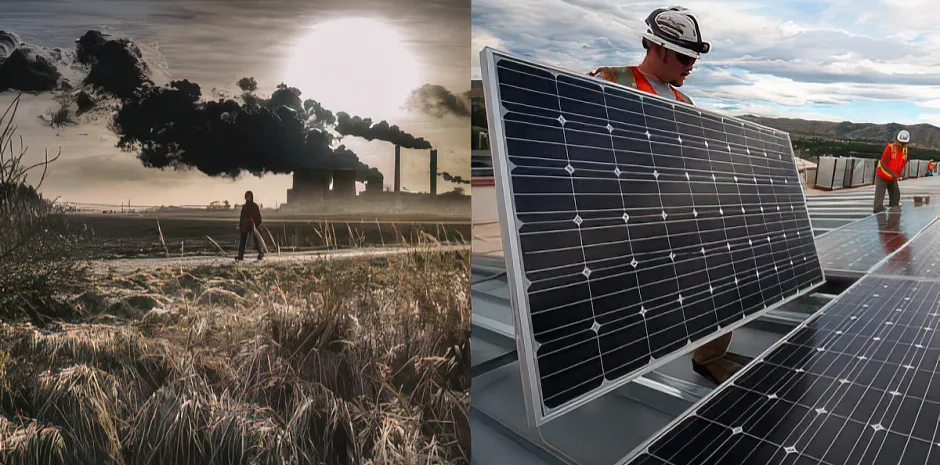
The 2018 IPCC report warns the world has just a decade to take “unprecedented” action to cut carbon emissions and hold global warming to a moderate, but still dangerous and disruptive level. This will require rapid and far-reaching transformation, one of such scale and magnitude that has no historical equivalent. The time is ripe for the federal government to step up and move Canada towards a low-carbon economy and sustainable society. But what kind of changes are necessary?
We created an interactive scenario explorer that depicts likely outcomes from different development paths, based on degrees of institutional and social change explored during our Meeting the Climate Change Challenge (MC3) project. Comprised of three scenarios—incremental, reformative, and transformative change—it illuminates the different ways our institutions, communities, and societies could develop and operate in the face of global climate change.
Some believe we have yet to begin the necessary conversations, while others argue that there have been ongoing discussions for many decades that have gone unheard. Some stories, such as growth, have become so dominant that they have eliminated space for other perspectives. Changing the conversation is about re-enlarging public space and re-engaging different generations in virtual real-time e-Dialogues.
This intergenerational space is an experimental opportunity to rethink and reframe modern-day challenges relevant to Canadian communities and co-create innovative, scalable solutions. Governed by the principles of Socratic dialogue, this space hosts virtual real-time e-Dialogues and lead virtual peer-to-peer learning exchanges. It is also a repository for learning, best practices, tools and methodologies—a collaborative space to join or start a conversation.